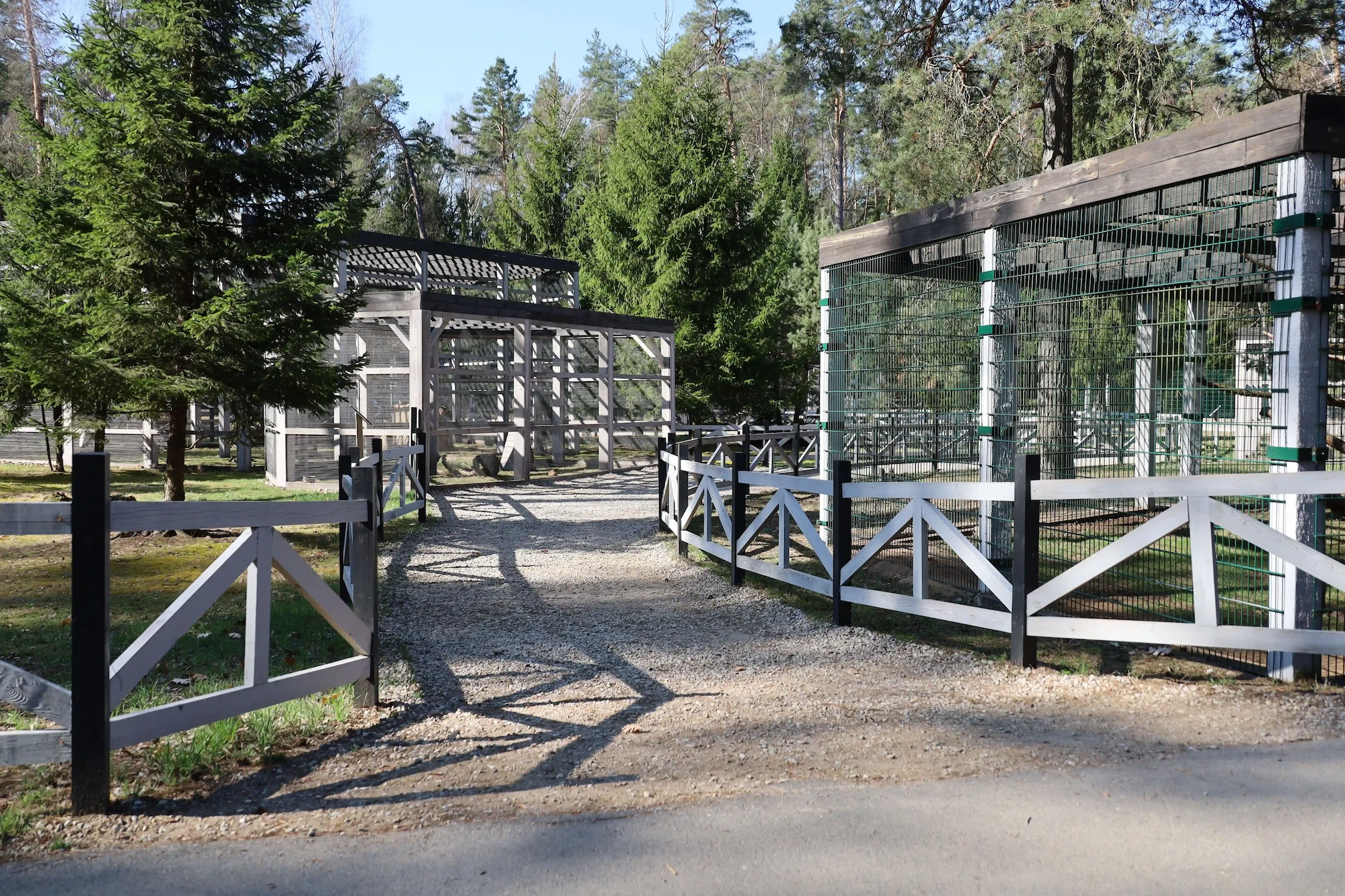
Tourist route «Animal crossing»
19 km bike route runs along paved and unpaved roads in the national park and is ideal for an adventurous family vacation.
Red oak. Red oak is a beautiful but dangerous foreigner. Its native land is North America. It appeared in Belovezhskaya Pushcha in the 1920s and 1930s, planted as part of a park ensemble.
Decades passed, and the “guest” began to invade the native forests. The red oak is unpretentious. It lives much shorter than the native pedunculate oak, and its wood is only suitable for heating stoves. Its seeds are quickly dispersed by jays and provide food for deer and wild boar during the winter.
«Hermit» Oak. A floodplain meadow once stretched across this site. The oak that grew on its edge captures the former landscape. The tree is unusual for a dense stand of trees. Its stocky silhouette is typical of oaks growing in open spaces. Such giants don’t grow very tall, but they quickly “grow fat.” This tree is approximately 300 years old, and its trunk diameter is already 1.5 meters! The oak had three main branches, but in the 20th century, a hurricane broke one of them. A large hollow opened in the trunk, which has become home to many living organisms.
Spruce forest. (52.564940, 23.826234) Forests dominated by Norway spruce occupy more than 4% of the forested area in Belovezhskaya Pushcha. Spruce is common in various stands. It is highly shade-tolerant, but due to its shallow root system, it often suffers from windfalls and frequent fluctuations in groundwater levels. It reaches a height of 35-50 m. Individual trees live up to 300-350 years. The needles remain green for 7-9 years.
Forest Pond. (52.564444, 23.828723) Small ponds are hidden in various corners of the forest. These artificial ponds were dug during the Soviet era, when Pushcha was considered not only a nature reserve but also a model hunting ground. There are over fifty ponds in total, created as watering holes and fire reservoirs. Over the decades, amazing communities of unique plants and animals have formed here, adding even more diversity to the green world of the ancient forest.
Giant Pines. (52.562154, 23.835732) The enormous pine trees along the road belong to the honorable category of giant trees. These beauties, with their broad, copper-colored bark, are over 250 years old, with trunks nearly a meter thick. These trees aren’t record-breaking; there are hundreds of enormous pines in Pushcha. Even more impressive specimens can be found. Nevertheless, these pines are a vivid example of the beauty and strength that nature bestows upon the species.
Baruschichi tract. (52.556644, 23.845231) The drainage of the Baruschichi swamp was carried out in the late 1960s. The drainage was justified by the need to expand biotechnical areas to increase the population of wild ungulates. The drainage of the swamp resulted in a lowering of the groundwater level directly within the swamp, the drainage of the forested wetlands adjacent to the swamp, and the mineralization of the peat.
The re-wetting of the Baruschichi swamp contributed to the optimization of the hydrological regime, the renewal of peat formation processes, moisture storage, and the conservation of rare bird species (lesser spotted eagle) and plant species (orchids).
Kislyaki Tract. (52.554298, 23.847809) The tract’s unique location lies on a so-called dune (elevation) in the floodplain of the Pravaya Lesnaya River. Such dunes are considered sites of high natural value and are of strategic importance for maintaining the National Park’s biodiversity.
Maps from the 1930s show only one or two farms in this area. At that time, the place was called «Dvorishche.»
During the Soviet era, up until 1941, there were seven farms in this and adjacent areas, and the neighboring tracts were called «Kislyaki» and «Shershni» (Shershni), after the surnames of local residents.
During the war of 1941-1944, the fate of these small villages took a tragic turn, as a result of which they were never revived.
Oak, a witness to centuries. (52.552579, 23.852049) This witness of the past is over 300 years old. It began growing on an elevated site amidst a swampy forest during the times of the Polish-Lithuanian Commonwealth. Its current diameter is approximately 1.3 meters. This is not uncommon in the Bialowieza forests. In this respect, the Pushcha has no equal in Europe. Scientists claim that the biological lifespan of oaks can reach 1,500 years. Such old-timers are absent in Bialowieza, perhaps due not only to humans but also to the elements. However, in the protected thickets, one can still see colossi at least 700 years old, with trunks exceeding two meters in thickness! It’s an incredible sight: after all, such trees remember ancient hunters with bows and arrows in hand.
«Lava» rest area. (52.544967, 23.858346) The rest area is located near the Lava Tract, or “Shukhali” (local name). Today, there are two rest areas: one with a gazebo, fire pit, and barbecue, and the other, on an island in the Lava Lake. This area was previously inhabited by the indigenous Pushcha people, whose surname was mostly “Shekhalevich.” Today, an inquisitive eye might notice mounds—the remains of the foundations of a vanished village. As far as is known, the area was already inhabited in the 17th century—named lands were located here. There was also access to the river floodplain, where sedge farmers harvested hay for bison, and farmers for livestock.
The name “Lava” is symbolic and signifies that here, at the crossing point through the marshy area, masonry was laid to facilitate the crossing.
Wildlife of Belovezhskaya Pushcha. (52.538960, 23.867496) Wild forest thickets and impenetrable wilderness conceal from prying eyes the habitats of the numerous creatures that have long inhabited Belovezhskaya Pushcha. The rich and diverse fauna places this ancient forest among the most valuable natural monuments in all of Europe.
Mammals of Belovezhskaya Pushcha are currently represented by 67 species, 14 of which are listed in the Red Book of Belarus. Of these, the most intriguing is undoubtedly the bison – the original ruler of these lands, a unique animal, the rarest and largest on the European continent. Today, more than 700 bison live in the Belarusian part of Belovezhskaya Pushcha. Along with the bison, other ungulates found in the forest include red deer, roe deer, elk, and wild boar. There are 12 species of predatory mammals. The largest of these are the wolf, lynx, fox, raccoon dog, badger, and otter. Smaller mammals include the stone and pine marten, American mink, polecat, ermine and least weasel. Common insectivorous mammals include the hedgehog, mole and shrew.
Rodents are the most numerous order of mammals, numbering 21 species in Belovezhskaya Pushcha. Among them are rare species such as the mouse mouse, the little mouse, dormice, hamster and voles, as well as common ones such as the brown hare.
Five of the 17 bat species found in the Pushcha are listed in the Red Data Book of the Republic of Belarus. These include the lesser noctule bat, the barnacle bat, the northern bat and Brand’s and Natterer’s bats. Belovezhskaya Pushcha is the only habitat in the country for the latter species. The forest’s avifauna is rich and diverse. It is home to over 250 of the 310 bird species recorded in Belarus. Thanks to its well-preserved biotopes, the forest supports 64 bird species listed in the Red Data Book of the Republic of Belarus. It is no coincidence that Belovezhskaya Pushcha and the Dikoye Marsh (home to the extremely rare Aquatic Warbler) are designated Key Bird Areas of international significance.
Seven species of reptiles and 11 species of amphibians have been recorded in Belovezhskaya Pushcha. Common species include the grass snake and sand lizard, newts (common and crested), fire-bellied toad, spadefoot, tree frog and three species of frog and toad.
The ichthyofauna of Belovezhskaya Pushcha is represented by 27 species of fish and a brook lamprey. Common species include roach, perch, ruff, pike, gudgeon, tench, and crucian carp (Prussian carp and crucian carp).
4,355 insect species belonging to 19 orders have been recorded in Belovezhskaya Pushcha National Park. Among the fauna of Belarus, 28 species are known only in Belovezhskaya Pushcha. Forty-four insect species from five orders listed in the Red Book have been recorded here. Habitats have been identified for at least 150 insect species with conservation status in Europe (IUCN Red List, Bern Convention, Council of Europe Habitat Directive, etc.). A distinctive feature of the coleopteran fauna of Belovezhskaya Pushcha is the presence of approximately 900 insect species living in dead wood at various stages of decomposition.
«Yazvy» (Ultras) tract. (52.544484, 23.888362) This is an extremely interesting place. The surrounding forests are a favorite habitat for bison, deer, wild boar, foxes, and badgers. Incidentally, the place got its name from the latter. In ancient times, the badger was called «yazvets.»
Another unique feature of the area is its long history of economic use (grazing, cultivating land plots, beekeeping, and hunting). Now a young forest has been planted here, and in a few decades, this area will be unrecognizable.
Oak That Conquered Lightning. (52.544484, 23.888362) Many oaks in Belovezhskaya Pushcha bear the marks of lightning strikes. Of course, thousands upon thousands of thunderstorms have raged above them for hundreds of years. It is precisely this long period of time that determines the frequency of encounters with the monstrous energy of the heavens. Mighty trees become unique conductors or “lightning rods.” Oaks are particularly susceptible to lightning strikes, as their dense, moist wood structure allows for superior electrical conductivity compared to other trees. After a lightning strike, trees often emerge victorious, even with enormous black hollows inside, surviving for a long time.
Burled oak. (52.544484, 23.888362) Burls are growths on tree trunks. They form due to forest pathology. Trees with burls are less valuable for processing, so in normal forests they are the first to be felled for sanitary logging. Human influence is very limited in Belovezhskaya Pushcha, so burls are often seen on a wide variety of trees. Sometimes these growths exceed one meter in size and the rare intricacy of their texture and shape evokes thoughts of forest and cultural «architecture».
Predatory Mammals of Belovezhskaya Pushcha. (52.567064, 23.890894) There are 12 species of predatory mammals living in the national park. The largest of these are the wolf, lynx, fox, raccoon dog, badger and otter. Small predators include the stone and pine marten, American mink, polecat, ermine and least weasel.
As is well known, each species occupies a suitable habitat. Many animals try to mark the boundaries of their habitat to warn other forest dwellers that the area is already occupied. To do this, they leave distinctive markings in visible places: secretions from scent glands, excrement, notches, or scratches on tree bark.
Such marks left by lynxes can be seen near the route. The cats thus indicate their presence by scratching tree trunks while standing on their hind legs. Incidentally, this same habit is common to bears. The habit of «sharpening its claws» has a signaling value and indicates that the area is already inhabited.
Animal Crossing. (52.569275, 23.890983) The forest is crisscrossed with animal trails. Some are barely noticeable, while others are very busy. The secret to this place’s popularity is simple: the road, which runs across the moraine ridge, is often crossed by animals at the highest point of the excavation. This happens because the ridge is easier and safer for animals to move along. Another advantage of this crossing is that track marks in the snow on the southern slope disappear during the winter.
A giant pine with root «paws.» (52.569232, 23.879967) This giant pine, with a trunk approximately 1.2 meters thick, is noteworthy not only for its impressive size. It differs from its relatives in the shape of its root “paws.” They project outward, like powerful supports for a tall tower. This allows the trees to root better in swampy conditions and exposed to high wind loads. They also have a better chance of surviving even strong storms. This mighty pine has been standing for over 300 years, reaching a height of 38 meters.
Former narrow-gauge railway. (52.569105, 23.866931) When traveling through the relic forest, the route most often follows a grid network or winding paths. However, there are also some old and little-used roads with engineering solutions. In most cases, these routes are the sites of narrow-gauge railways from the last century.
Their history begins on August 17, 1915, when a network of sawmills and resin factories was built in the Belovezhskaya Pushcha region.
To provide infrastructure for the supply of raw materials, construction of a narrow-gauge railway network began in the spring of 1916. This created a network of 130 km of main tracks and a mobile (portable) network of approximately 200 km.
Up to 1 million cubic meters of timber were transported annually along the Pushcha railway network. In the post-war period (around the mid-1960s), their use practically ceased. The Belarusian section of the road was dismantled.
At a fork in the forest. (52.569232, 23.859471) The crossroads near the 828th square, where the Tsarskaya Polyana recreation area is located, are a landmark for the national park. For a long time, this was not only a crossroads but also a point of common interest. Since tsarist times, forest guards and their families lived here. There was always a well here where people could quench their thirst and water their horses. Houses stood on this property until the 1960s.
Nearby, on the southern side, a permanent weather station for long-term monitoring was located here during the Soviet era. About 80 meters north of the crossroads, the paved road is crossed by the inconspicuous, overgrown old Yasenskaya Road, which was heavily used before the construction of the narrow-gauge railway in 1915.
Century-old pine forest. (52.567469, 23.842739) Pine-dominated forests occupy 63% of the forested area of the forested forest. Before us is a magnificent example of an old pine forest. The average age of its trees is approximately two centuries. Few protected areas boast such magnificent stands. Many of these striking pines grew on the sites of a fire that raged in 1811, on the eve of Napoleon’s invasion. Today, these forested areas are valuable monuments to the power of living nature, having been reborn without any human intervention.
Phone: +375 33 399-19-32
E-mail: admin@npbp.by
 Gazebos
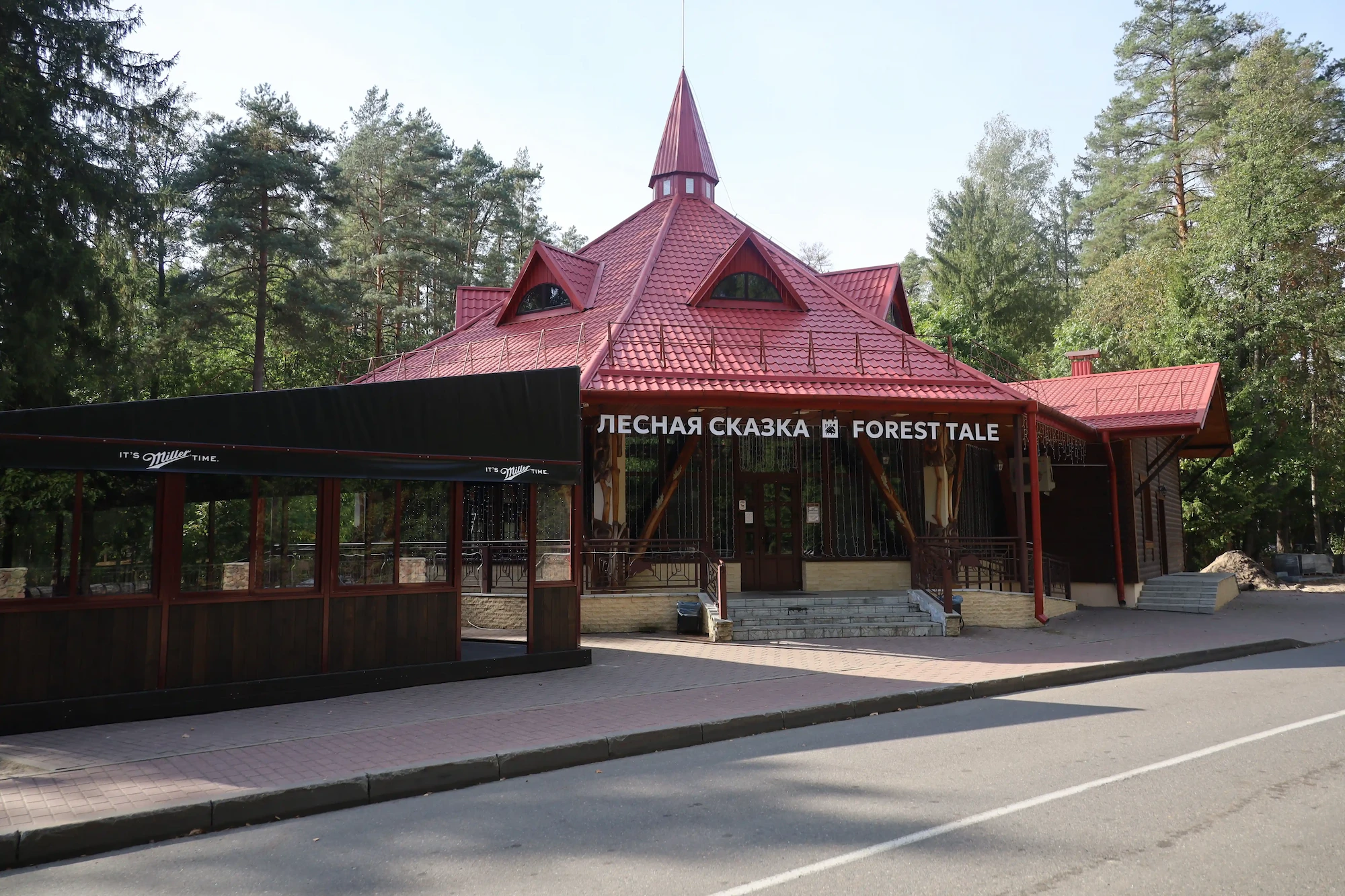
Shop
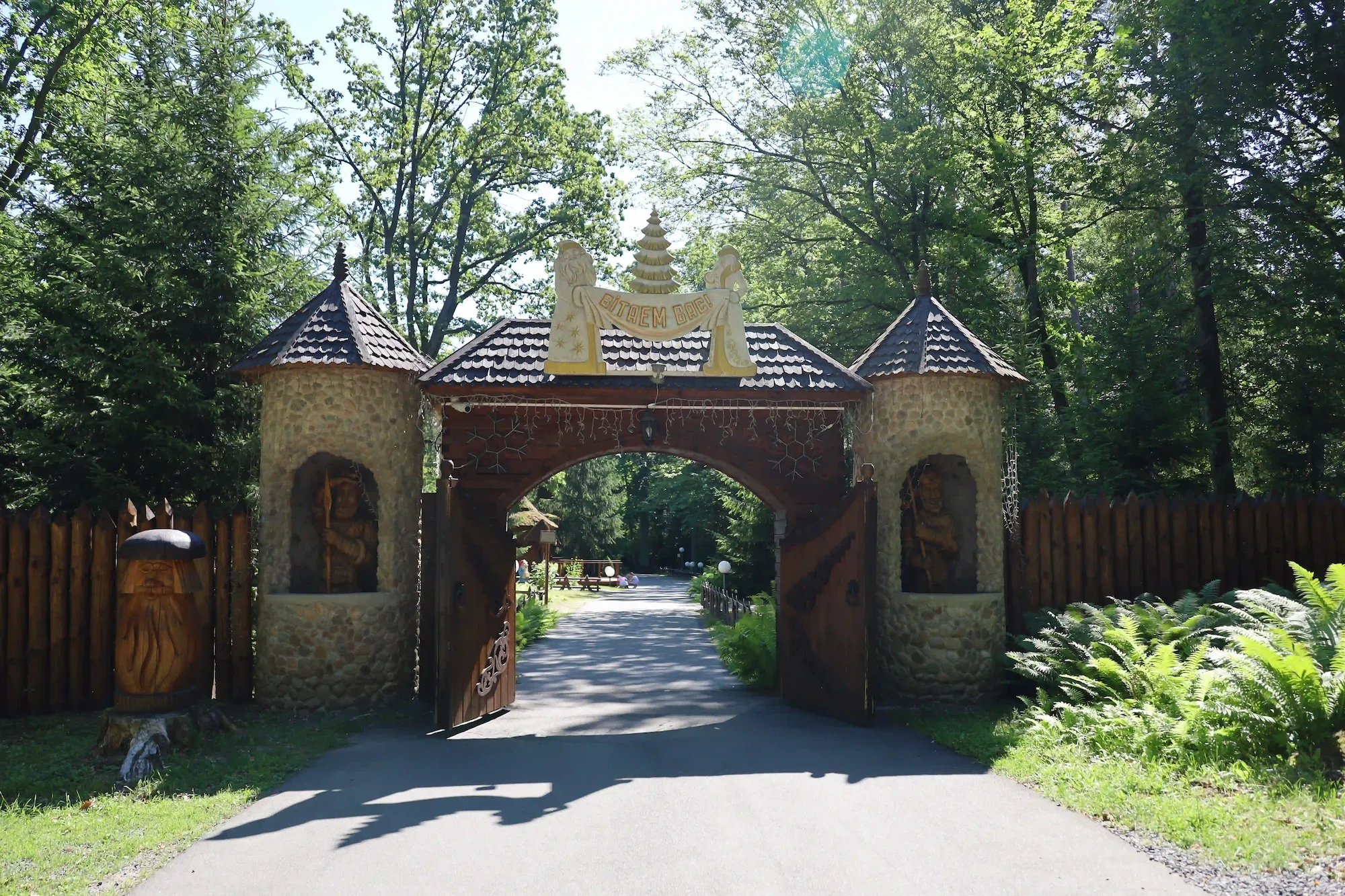
Santa Claus's Estate
The route is equipped with information boards
Gazebos
Shop
Santa Claus's Estate
The route is equipped with information boards
 Navigation assistance along the route
Emergency assistance in case of breakdown of the rental bicycle
Bicycle rental
Navigation assistance along the route
Emergency assistance in case of breakdown of the rental bicycle
Bicycle rental
Log in to leave a review.