Viewpoints (similar to those found along the «Grand Journey» route; including navigational reference):
- Red Oak. The red oak is a beautiful but dangerous foreigner. Its native land is North America. It appeared in Belovezhskaya Pushcha in the 1920s and 1930s, planted as part of the park’s ensemble. Decades passed, and the “guest” began to invade the native forests. The red oak is unpretentious. It lives much shorter than the native pedunculate oak, and its wood is only suitable for heating stoves. Its seeds are quickly dispersed by jays and provide food for deer and wild boar during the winter.
- «Hermit» Oak. A floodplain meadow once stretched across this site. The oak that grew on its edge captures the former landscape. The tree is unusual for a dense stand of trees. Its stocky silhouette is typical of oaks growing in open spaces. Such giants don’t grow very tall, but they quickly “grow fat.” This tree is approximately 300 years old, and its trunk diameter is already 1.5 meters! The oak had three main branches, but in the 20th century, a hurricane broke one of them. A large hollow opened in the trunk, which has become home to many living organisms.
- «Tatar Bagno». (Tatar swamp) According to legend, during the Tatar-Mongol campaigns, nomadic troops reached Belovezhskaya Pushcha and set up camp there. It was located on a rise in the middle of a swamp. Impenetrable flooded forests protected the camp from surprise enemy attacks. Local residents still call it “Bagno.” The terrible swamp has now dried up and is overgrown with shrubs and alders, but in the spring, the “Bagno” remains impassable. The rest of the year, tall hummocks and beautiful irises serve as reminders of its existence.
- Turlyuy Tract. The name of this tract is mysterious. It is located near significant forest road intersections and on the border between marshy and dry land. It is believed that the name derives from the Polish “turlają” (to roll), which likely indicates that this was the location of a transshipment base in the distant past. It should be noted that it has been marked on maps since the mid-19th century.
- Fused Pines. In Bialowieza Primeval Forest, the thickets are so dense that even sunlight cannot penetrate the tightly closed tree crowns. Sometimes the trees grow so close together that their trunks touch and rub against each other in the wind. This can damage the bark and branches. Tightly adjacent sections of trunks often grow together, creating a natural “graft” of one tree to another.
- Forest Nursery. Belovezhskaya Pushcha Forest Nursery has been operating since 2011. Here, on an area of 7.5 hectares, the forest of the future is being “created.” Every year, 2.5 million seedlings of unique forest-forming native forest plants are grown and used as planting material for the national park. This helps maintain economic activity in balance and harmony with the natural processes occurring in this pristine area.
- Former Narrow-Gauge Railway. Traveling through the relic forest, the route most often follows a network of roads or winding paths. However, there are some rather old and little-used roads with engineering solutions. In most cases, these routes are the sites of narrow-gauge railways from the last century. Their history begins on August 17, 1915, when a network of sawmills and resin factories was built in Belovezhskaya Pushcha region. To provide infrastructure for the supply of raw materials, construction of a narrow-gauge railway network began in the spring of 1916. This created a network of 130 km of main tracks and a mobile (portable) network of approximately 200 km. Up to 1 million cubic meters of timber were transported annually along the Pushcha railway network. After the war (around the mid-1960s), their use virtually ceased. The Belarusian section of the railway was dismantled.
- Centuries-old oak forest. This forested area can safely be called the “Golden Fund” of the Pushcha. The predominant tree species here is common oak, a typical feature of ancient forests in Central Europe. The average age of such a forest is approximately 300 years. The roots of these giants reach deep into the fertile soil and can extract life-giving moisture during any drought. This forest testifies to the excellent fertility of the local soils, which is one of the determining factors in the concentration of valuable plant and insect biodiversity.
- «Protected Oak Grove» Ecological Trail. «Protected Oak Grove» Ecological Trail passes through one of the most interesting places in the national park. Its distinctive feature is a four-hundred-year-old oak grove, growing where traces of human activity from the 15th and 16th centuries are still visible. This is a model «natural monument» that exemplifies the long-term, diligent conservation of wildlife.
- Forest plantation area. In 2002, a «hotspot» of massive spruce dieback appeared in this area, and a hurricane felled the surviving trees. The disaster created a natural training ground. The national park’s forestry service planted saplings in the area where the dead trees had fallen. Now, here, everyone can compare the differences between man-made and natural reforestation, appreciate the mosaic nature and high quality of natural resources, which clearly progresses more rapidly near the remaining forest area around the «hotspot.»
- Upper warehouse. In Belovezhskaya Pushcha, you can sometimes see regularly shaped rectangular clearings along the road. These are the sites of the former ” Upper warehouse.” During World War I, when logging was rampant, felled trees were transported to these cleared areas. A narrow-gauge railway ran along the clearing nearby, transporting the Pushcha’s pines, oaks and other valuable timber.More than a hundred years have passed. The narrow-gauge tracks have long been removed, but the clearings remain as scars—a reminder of the harsh trials that Belovezhskaya Pushcha endured. The term “Upper warehouse” itself originates from the practice of logging. In former times, tree trunks were delivered to the riverbank (Upper warehouse) to be floated downstream. At the lower end of the river, the logs were again collected into piles (Lower warehouse) to be transported to their final destination. Thus, over the years, the temporary timber storage areas located before the main depot became known as Upper warehouse.
- Giant Oaks. Giant oaks are the pride of Belovezhskaya Pushcha. These unique trees are unyielding to time and the elements. For centuries, in gratitude for their protection, they have provided humanity with essential oxygen, fed acorns to local wildlife, provided shelter to some of them, and are valuable donors of high-quality seeds.
- Ash Forest. In Europe, ash is classified as an “NT” species by the International Union for Conservation of Nature (IUCN) – Near Threatened. Ash forests are still found in Belovezhskaya Pushcha, but they grow only on fertile soils with a specific hydrological regime. A useful feature of this forest stand is the noticeable growth of moss on the north side of the ash tree trunks, which facilitates navigation in the remote areas of the national park.
- Black Alder. Black alder is the keeper of the Pushcha’s secrets. In ancient times, when the great forest was surrounded by impassable swamps, alder thickets conquered all the wet lowlands. Since then, as foresters say, alders have become the least disturbed vegetation complexes by humans. The «difficult» timber to obtain rarely attracted the greedy eyes of loggers, and the impenetrable thickets still invariably provide the best refuge for animals and birds.
- New forest on the site of clear-cuts. Clear-cuts during World War I and the 1920s were the largest logging operations in the entire history of the Białowieża Forest. More timber was removed than in the previous 500 years during the German occupation of 1915-1918 alone! Fortunately, the Polish authorities sought to mitigate the damage caused by industrial exploitation of the forest. Pine seedlings were planted in the clear-cut areas. Some clear-cut areas regenerated naturally, resulting in a mixed forest. Today, large areas near former narrow-gauge railways are home to young hornbeam, aspen, and birch trees – living reminders of past wounds.
- Wood-destroying fungi and insects (saprotrophs). A third of the national park is a completely protected area, allowing biological processes to continue naturally. A large amount of dead wood is the norm in such forests. Fungi and insects, in turn, break it down into digestible nutrients, making an invaluable contribution to the forest’s life cycle.
- Border Outpost. The state border divides the transboundary forest into Belarusian and Polish parts. Several border outposts are located within our national park, protecting the peace and quiet of both countries.
- «Royal Road». Beneath the smooth asphalt of this road lies the cobbled old tsarist “Brukovka.” A crucial road in its time, connecting Brest with the forest’s capital, the village of Belovezh, was built in the first half of the 19th century. Along its sides, you can see Polish cast-iron landmark posts. For hundreds of years, the horseshoes of horses pulling stagecoaches and noble carriages struck sparks on the cobblestones of this road.
- Plyanta – an object of repeated swamping. Historically, Belovezhskaya Pushcha is an area with a high degree of swampiness. The total area of swamps is over 40,000 hectares, or more than 30% of the territory. Over the course of history, the wetlands of the pushcha have been significantly developed by humans. 49% of the swamp area has been drained (16 swamps with a total area of 19,983 hectares), 12 small rivers have been straightened, and hundreds of forest reclamation canals have been dug. Due to land development in some areas of Belovezhskaya Pushcha, the groundwater level has dropped by 50–150 cm. Due to a lack of moisture, spruce stands suffered first, followed by ash stands. Therefore, the work carried out to restore the disturbed hydrological regime is particularly valuable for Belovezhskaya Pushcha. Thus, using the example of the restored water regime of the Plyanta object (work was carried out in 2016) of the Korolyovo-Mostovsky forestry, one can already observe the positive dynamics of natural processes from repeated swamping.
- «Dokudovo» cycling and walking route is located in the southern part of Belovezhskaya Pushcha; it passes through the tract of the same name, which is located on the site of an ancient raised bog drained in the 1960s and 1970s. For a long time, this area was used by the local population as pasture and hayfields. Currently, the area is a favorite haunt for deer, wild boar, foxes, and wolves. Occasionally, you can encounter bison here or see their tracks.
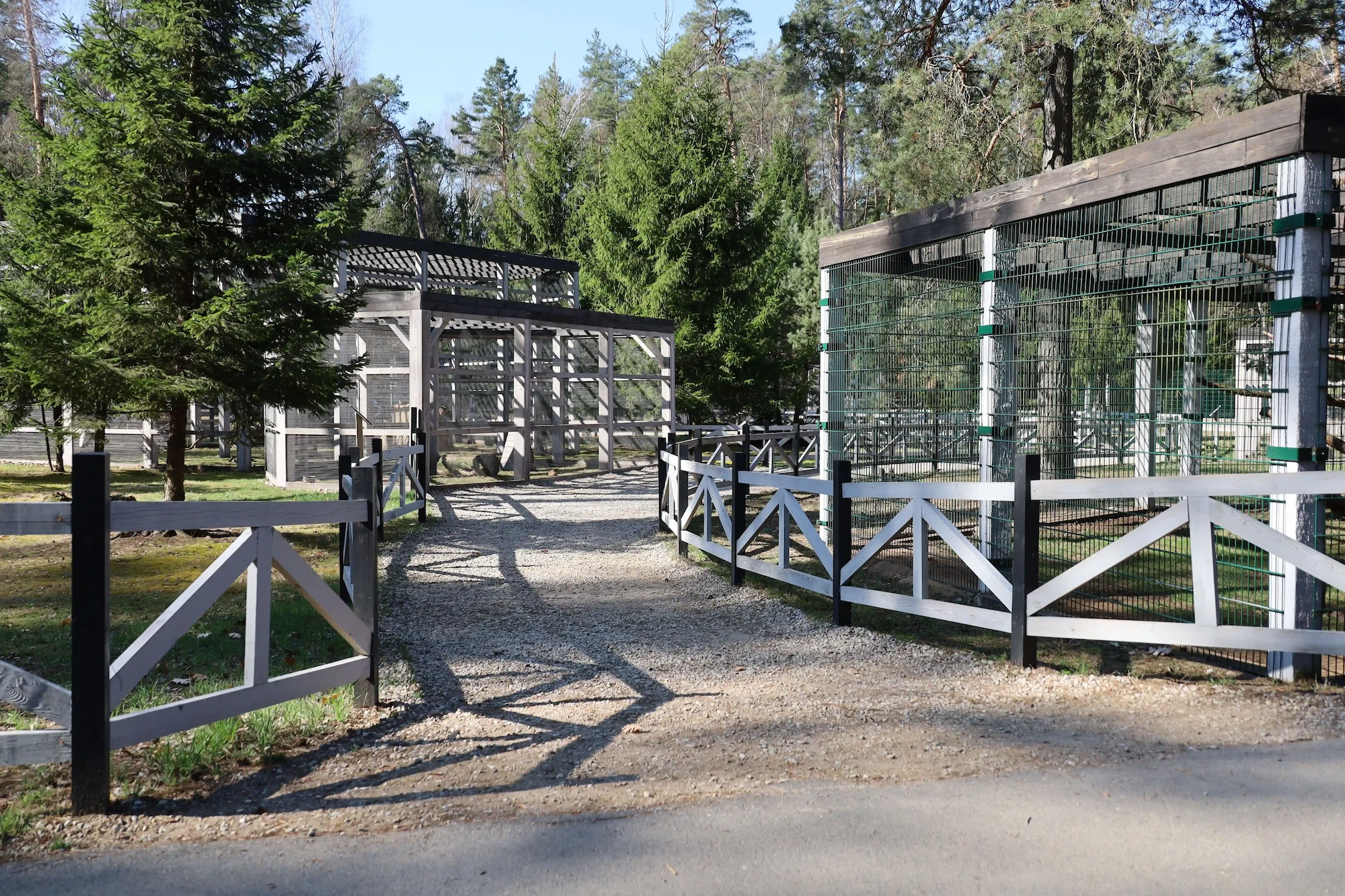
- Open air cages. A small forest zoo features demonstration enclosures with wild animals. Here, visitors to the national park can admire majestic bison, graceful deer and roe deer and see wolves, bears, foxes, as well as several species of birds of prey. In addition to native species, the cages also house several animals introduced to our country at various times: danely deer, sika deer and raccoon dogs. Visiting the animal open air cages requires an additional fee.

 Gazebos
 Navigation guidance along the route